
Enterprise Manufacturing Operations
Govern connected devices, lifecycle workflows, and mixed connectivity environments across manufacturing facilities with a unified operational control layer.

Powering Global Logistics and Supply Chain Operations
Keep Production Moving With Operational Control
Manufacturing environments rely on connected devices to keep production lines running, monitor equipment health, and support safety and compliance programs. Sensors, gateways, controllers, and mobile industrial assets operate across plants, warehouses, and remote facilities, often using different connectivity models and managed by different teams.
For manufacturing leaders, the objective is not simply managing connectivity. The real objective is device productivity — ensuring connected assets consistently contribute to production, safety, and operational efficiency. Achieving that requires more than connectivity consoles. It requires accurate discovery, trusted inventory, lifecycle governance, and operational context across the distributed network of industrial devices.
As manufacturing programs grow, operations become harder to coordinate. Devices stay in service for years. Connectivity changes over time. Ownership shifts between engineering, IT, and operations. What begins as a controlled deployment can quickly turn into fragmented systems that slow decisions and introduce risk.
Simetric helps manufacturing organizations regain control by providing lifecycle governance, unified operational visibility, and an authoritative decision layer for connected infrastructure at scale.

The IoT Connectivity Challenge in Enterprise Manufacturing
Manufacturing leaders are not short on data. The challenge is maintaining operational clarity as distributed networking environments expand across facilities, suppliers, and connectivity domains.
Connected devices operate across multiple facilities, suppliers, and connectivity providers. Some run on private networks, others on cellular backup or satellite links. Carrier IoT connectivity management platform (CMP) instances and fleet systems each provide partial operational views, and eIM fragmentation makes it difficult to maintain a consistent state across different regions or providers. Different teams use different tools to manage different parts of the lifecycle. Over time, this creates familiar problems:
- Device status becomes unclear
- Changes are made without shared context
- Connectivity decisions vary between facilities
- Operational history becomes difficult to trace
Traditional management tools often struggle here because they were built for static environments. Dashboards show pieces of the picture, but they rarely provide a consistent operational understanding across the full lifecycle.
The result is decision latency. Teams hesitate because they lack confidence in the data or cannot see how a change will affect downstream operations.
Single Pane of Glass (SPoG) for Manufacturing Device Operations
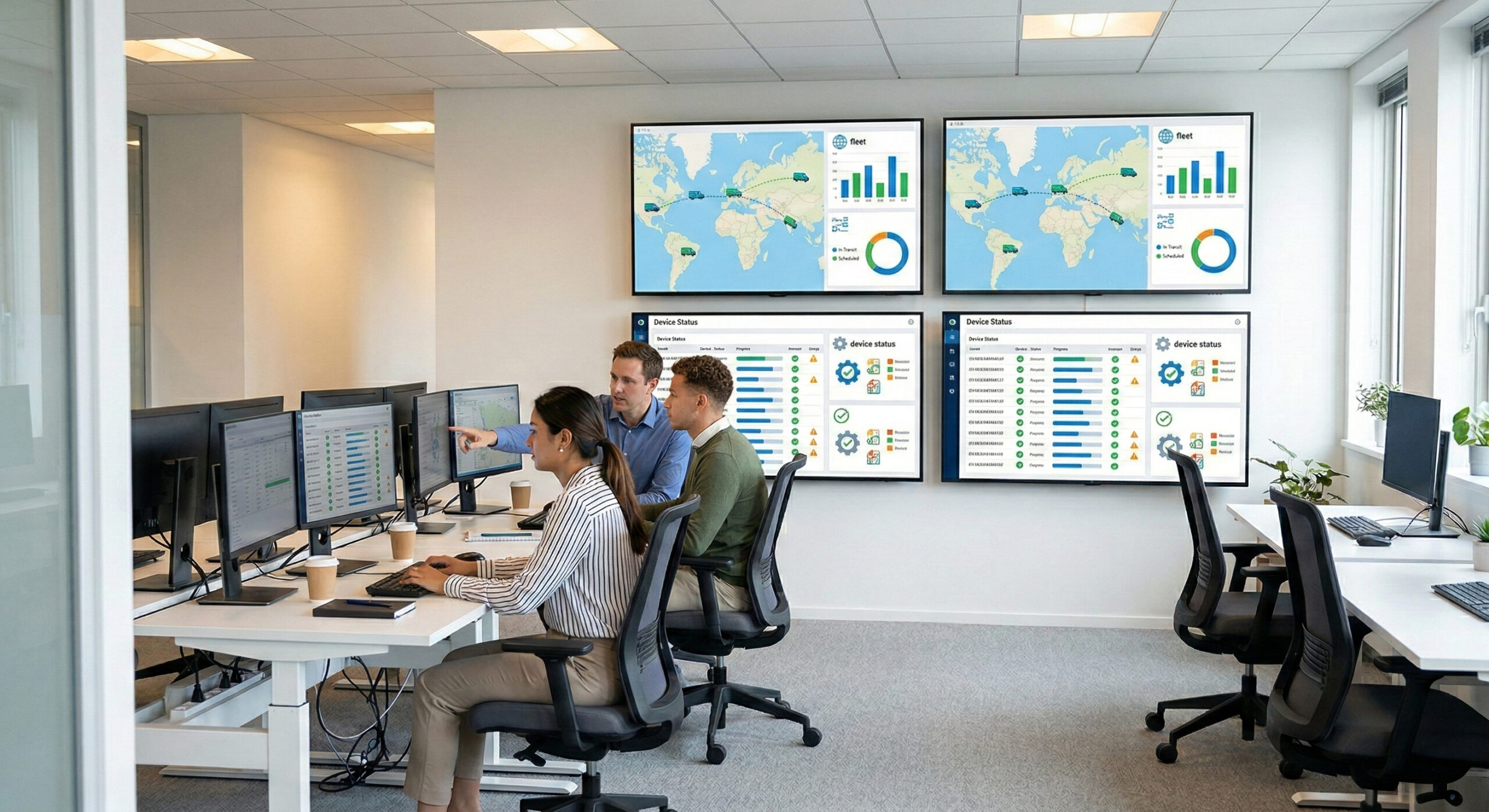
Simetric provides a Single Pane of Glass (SPoG) that acts as an enterprise operational control plane for connected manufacturing environments.
This is not another connectivity dashboard. It is a shared operational context that reconciles device, connectivity, and lifecycle data across carriers, facilities, and systems. Underneath this operational view is Simetric’s distributed networking data lake, which normalizes telemetry, lifecycle events, and connectivity state across SIM and eSIM environments.
Because device identity, connectivity posture, and operational history are reconciled into a common model, enterprises can pursue deeper analytical and agentic initiatives. AI systems can reason over operational context instead of isolated signals, enabling predictive insights, automated remediation workflows, and continuous optimization of device behavior across manufacturing environments.
For manufacturing organizations, SPoG enables

Continuous Asset Visibility

Unified Team Context

Clear Device Accountability

Fewer Blind Spots
Governing Full IoT Device Lifecycle in Manufacturing
Manufacturing devices are long-lived assets that must first be discovered and accurately inventoried before they can be governed across their operational lifecycle. They are deployed, updated, reassigned, and eventually retired, often over many years.
Without lifecycle governance, these transitions create risk. Devices may remain active longer than intended, policy changes may not apply consistently, and teams may lose track of operational history.
Simetric enforces policy-driven lifecycle governance through its enterprise IoT device management platform from onboarding through operations, change, and retirement. From onboarding through operations, change, and retirement. Connectivity changes follow standardized workflows that preserve traceability and auditability across facilities and providers.
This allows manufacturing organizations to scale connected infrastructure while maintaining operational consistency. Governance becomes part of everyday operations instead of an afterthought.

Managing Mixed Connectivity in Industrial Environments
Modern manufacturing environments operate as distributed networking systems rather than single-network environments. Cellular, private networks, satellite, SIM, and eSIM often coexist within the same enterprise.
Simetric operates above these environments as a centralized control layer. It does not replace carriers or connectivity platforms. Instead, it ensures consistent lifecycle governance and visibility across mixed environments.
eSIM orchestration plays a supporting role by enabling connectivity changes without physical intervention. When governed through Simetric, eSIM orchestration becomes an operational enabler rather than a source of complexity.
This flexibility helps manufacturers adapt as facilities evolve, suppliers change, or new connectivity requirements emerge.
Reducing Risk and Improving Decision Confidence in Manufacturing
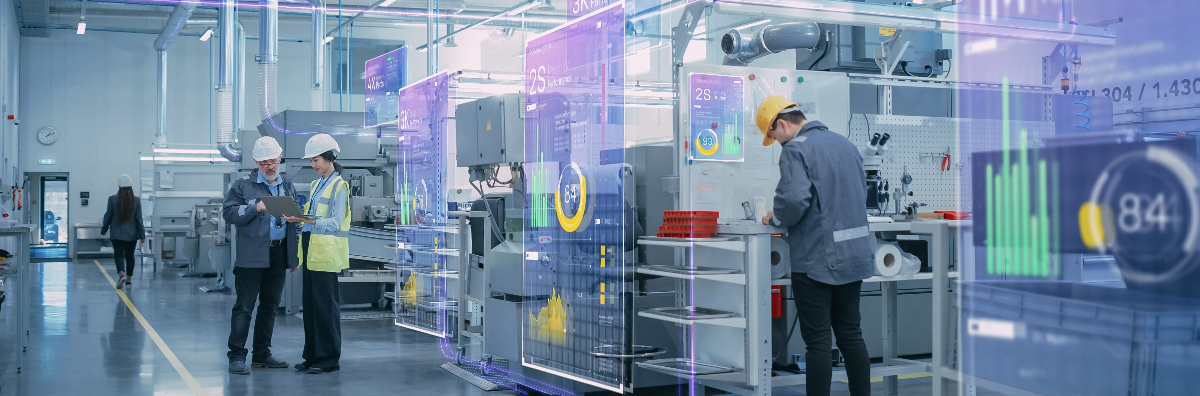
In manufacturing, risk often appears at the boundaries between systems and teams. A device update in one facility may affect production elsewhere. Connectivity issues can create downtime if teams lack clear context.
By reconciling lifecycle, connectivity, and operational telemetry into a shared intelligence layer, Simetric transforms raw device data into operational understanding. Instead of reacting to isolated alerts, teams gain the ability to understand system behavior across facilities, suppliers, and networks.
Simetric reduces these risks by preserving lifecycle history and operational context alongside real-time visibility. Teams can see not only what is happening now, but how and why conditions changed over time. This improves decision confidence by allowing teams to:
- Respond faster to operational exceptions
- Understand ownership and change history
- Maintain audit-ready records
- Reduce unplanned downtime caused by fragmented processes
Operational clarity supports production continuity, which is critical in manufacturing environments where delays can quickly become costly.


Manufacturing Operations Built for Scale and Accountability
Manufacturing success depends on more than connectivity management. It depends on operational control of distributed industrial infrastructure. It requires control, governance, and shared operational truth across facilities and teams.
Simetric helps manufacturers move beyond fragmented tools by providing an enterprise orchestration layer for connected industrial infrastructure. Organizations can scale deployments without sacrificing accountability or introducing operational inconsistency.
As connected manufacturing environments expand, governance becomes the foundation that allows adoption to continue safely and predictably.