
A Simetric Perspective
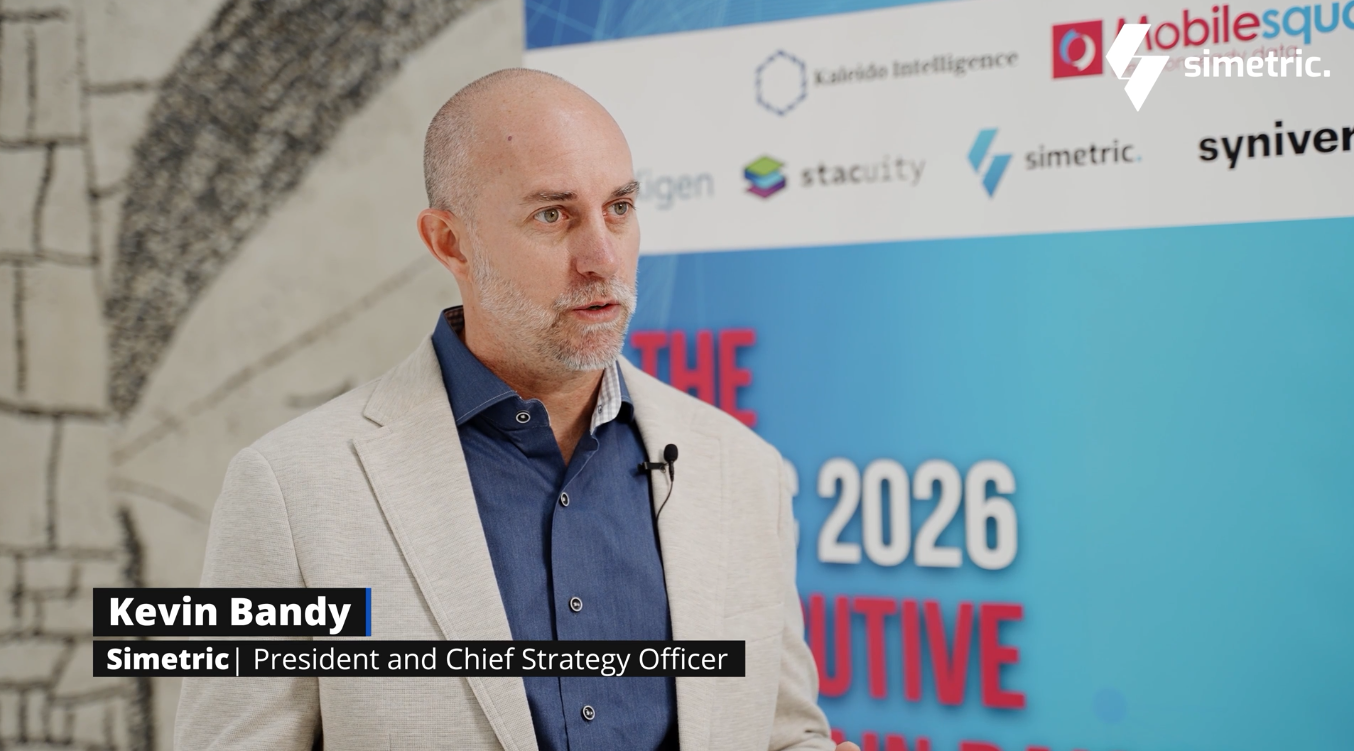
At Mobile World Congress 2026, Simetric’s Kevin Bandy shared a forward-looking perspective on how enterprise priorities are reshaping the future of cellular IoT.
While the industry has long centered around connectivity, Bandy highlighted a clear shift already underway—one driven not by networks, but by data, security, and device-level productivity. As enterprises scale their IoT environments, decision-making is increasingly moving into the hands of CIOs and CISOs, who are tasked with unifying and securing complex device ecosystems across the business.
This shift is not incremental. It represents a fundamental change in how IoT is defined, managed, and operationalized.
The Shift From Connectivity to Enterprise Control
 For years, IoT strategies were largely anchored in connectivity, such as tracking SIMs, managing carrier relationships, and monitoring usage. According to Bandy, that model is no longer sufficient. Enterprises are now prioritizing:
- Data visibility across devices
- Security at the device and network level
- Operational productivity of connected assets
This evolution is pushing IoT firmly into the domain of enterprise IT leadership. Instead of being treated as a telecom function, IoT is becoming a core networking and security initiative, requiring centralized governance and deeper operational control.
eSIM Moves From Technology to Security Strategy
One of the most notable trends heading into 2026 is the reframing of eSIM. Rather than being viewed as a convenience or connectivity upgrade, eSIM is increasingly being adopted as a security deployment mechanism. The conversation is no longer about:
- Whether eSIM works
- Or which providers support it
Instead, enterprises are focused on:
- How eSIM enables secure device provisioning
- How it supports scalable, policy-driven deployments
- What it changes about operational control across global fleets
Adoption, not just availability, is where the real transformation is happening.
Redefining “Single Pane of Glass” for the Enterprise
Simetric’s “Single Pane of Glass” concept is rooted in a different starting point than traditional platforms.
Where many solutions approach IoT from a carrier or connectivity perspective, Simetric is built for the enterprise, specifically for CIOs and security leaders who need to unify fragmented environments. This means:
- Aggregating visibility across global carriers and networks
- Providing customizable control aligned to enterprise policies
- Treating IoT as a networking discipline, not a billing or connectivity function
The result is a platform designed to give enterprises full ownership over their IoT ecosystems beyond simply tracking usage or managing SIMs.
Why Device-Centric Management Changes Everything
At the core of Simetric’s approach is a shift to device-centric management. Historically, IoT environments have been treated as large, uniform systems. But in reality, devices serve vastly different roles as some are tied to revenue, others to security, and some to public safety.
A device-centric model enables enterprises to:
- Define individual performance criteria per device
- Apply specific rules and policies based on use case
- Align device behavior with business outcomes and risk profiles
This level of granularity unlocks a new layer of operational control, one that was not possible in connectivity-first models.
As IoT continues to scale into billions of devices, this approach becomes less of an advantage and more of a necessity.
Transcript
Q: What’s the biggest topic shaping the future of cellular IoT in 2026?
Kevin Bandy: There’s two things that we’re actually seeing right now. Historically, IoT has been tied very heavily to connectivity. There’s a fundamental shift of enterprises prioritizing data and security in the productivity of the devices. So you’re really seeing a categorical shift to where CIOs and CISOs, heads of security, are the single points of active driving of unifying IoT across their entire enterprise state.
Q: What excites you the most coming to MWC?
KB: What I find most exciting right now is the fact that eSim is a security topic. So you’re seeing a great deal of interest, but the interest is not in eSim as a technology; it’s really eSim as a security deployment mechanism.
And so that is a big focus that we’re having right now. And it’s not just the selection of eSim, it’s the adoption of it. Because the adoption has categorical changes to how these companies are all operating.
Q: Simetric is often referenced as an “enterprise-first device agnostic” platform. Could you share more on what that means?
KB: When we started a Single Pane of Glass as a platform, you have to understand I came from being part of Cisco’s leadership team, and so I was actually able to see the world’s largest networking company and actually understand where their portfolio began and where it ended. And then understand where there was a fundamental gap in how people were using IoT, which I see as a networking technology.
And so the Single Pane of Glass was to unify visibility between all of the carriers on a global basis, but to create a platform that the CIO or a head of security can tailor to their exact needs. So the MNOs are not our customer base; it’s the enterprises to be able to unify all of their IoT ecosystem and monitor not only the expense, but tailor the exact procedures and the value of their devices, and manage it as a networking component. True focus within IT, not connectivity.
Q: Being device centric implies that there may be more value to be achieved than other ways enterprises have managed IoT. What are you unlocking in this approach?
KB: Device-centric really gets down to being able to tailor the exact rules of an individual device. So if you look at the fact that there are billions of IoT devices, people historically manage them as one big monolithic environment when they look at it as connectivity. Yet some may be revenue dependent, some may be security dependent, some may be public safety.
Being device-centric, we created a platform that allows us to tailor the exact performance criteria down to the individual device, and that was something that nobody had been able to provide in enterprise.