
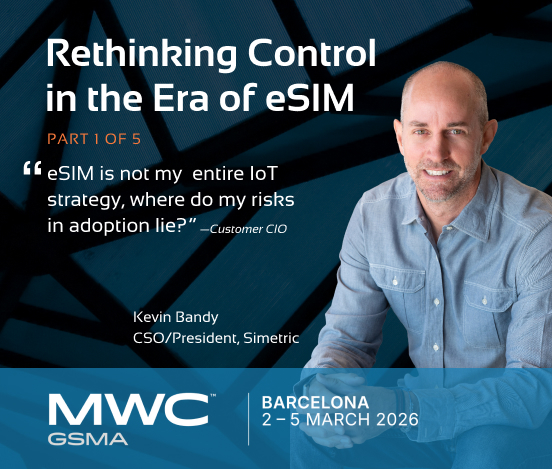
Part 1 of 5: Rethinking Control in the Era of eSIM
IoT is no longer an isolated connectivity technology. It is no longer an expense line item buried inside operations or IT. It is mission-critical network infrastructure—and enterprises or organizations that still treat it as an ancillary network focus are already behind, and likely at risk.
The signal is unmistakable. ServiceNow’s acquisition of Armis was not about tools; it reflects a broader transition to enterprise-led control where visibility, governance, compliance and security across distributed environments are now CIO, COO and CISO level imperatives commonly shared across their responsibilities. Performance and security require unified control.
That shift fundamentally changes the rules of IoT connectivity.
Despite the signal that control is pivoting to the market, or enterprise-first, Mobile Network Operators (MNOs) and virtual operators remain essential. Their networks power the connected world, and the data they generate is among the richest operational intelligence available. But for too long, that intelligence has been locked inside legacy platforms—designed for operators, not enterprises. As IoT explodes in scale and business criticality, that model no longer holds.
eSIM Adoption Can Benefit Further Enterprise Control
The IoT market already exceeds $400B, with billions of devices deployed globally. Over the next decade, that number will climb toward 40 billion devices. Managing connectivity, security, compliance, and cost at that scale is not a future challenge—it is today’s reality.
eSIM is often presented as the solution. Dynamic operator selection. Global flexibility. No physical constraints. These benefits can be real but require discipline to achieve.
But eSIM does not fix industry fragmentation across device manufactures, MNOs, or platforms. In fact, without deliberate architectural decisions, it accelerates it.
The mistake enterprises are making is assuming that adopting eSIM equals progress. It does not. eSIM is an innovative technology, not a strategy. Without the right control plane, organizations will simply recreate the same silos, the same lock-in, and the same operational blind spots—only faster and at far greater scale. The full aspects of adoption must be taken into consideration to be prepared to manage at scale and at the dynamic paces eSIM enables.
Legacy Platforms Are the Hidden Constraint in Adoption
Connectivity Management Platforms (CMPs) were built for a different era. In cases, too voice-centric in design, retrofitted for data, and optimized for operator efficiency—not enterprise agility.
Early CMP standardization simplified multinational deployments. But over time, CMPs became proprietary control points, tightly coupling enterprise workflows to operator-specific platforms. What should have been neutral infrastructure evolved into competitive differentiation for operators—often at the enterprise’s expense.
Today, many of these platforms are fundamentally incompatible with modern IoT requirements. They were not designed for eSIM orchestration, multi-operator abstraction, modern data strategies or real-time integration with enterprise security and analytics stacks.
Enterprises planning eSIM adoption without confronting this reality are building on a structurally unsound foundation.
Fragmentation Is No Longer Tolerable
As IoT scaled, cloud-based IoT cores reduced costs for MNOs and enabled support for multiple CMPs. CMP vendors responded by differentiating aggressively. The result is an industry ecosystem defined by inconsistent APIs, uneven capabilities, limited interoperability, and delayed visibility.
The cost to enterprises is measurable and growing:
- Escalating integration and customization spend
- Redundant operational processes
- Excessive usage fees
- Limited real-time insight
- Slower incident response and weaker security posture
Fragmentation was damaging when IoT was peripheral. At mission-critical scale, it is unacceptable.
Introducing eSIM without addressing this fragmentation does not modernize IoT. It multiplies risk—at a scale that is projected to be nearly eight times larger.
The Control Plane Enterprises Actually Need
Leading enterprises are responding by redefining where control lives.
Single Pane of Glass (SPoG) platforms have emerged as the enterprise control plane—abstracting CMPs, normalizing inconsistencies, and unifying SIM and eSIM management across operators and vendors. A SPoG works in an integrated manner with an eIM’s remote SIM provisioning (RSP) to ensure carrier side execution. A tightly coupled workflow experience for the benefit of users.
For business leaders, this shifts leverage. Control of cost, performance, and risk moves back inside the enterprise. Connectivity becomes a governed asset, not a negotiated dependency.
For IT and security leaders, SPoG platforms restore operational coherence—supporting unified observability across IT, OT, and IoT, elevating security posture, monetizing the data from all devices and enabling agentic, device-centric governance at scale.
Most importantly, SPoGs deliver unification without recreating lock-in—a critical distinction as eSIM platforms begin differentiating beyond GSMA standards and risk inadvertently fragmenting the ecosystem all over again.
This Time, Enterprises Choose Differently as We Move Into the eSIM Era
The industry does not lack experience from the last 20 years. Fragmentation will not be tolerated. It is a solved lesson. Device level control, full data access, real-time insights and enhanced security posture now define the expectations of the C-suite.
Enterprises and administrators now have the opportunity—and the responsibility—to adopt eSIM deliberately. That means pairing eSIM with an architectural strategy that unifies control across legacy SIMs, eSIMs, CMPs, and operators.
IoT is essential infrastructure. It deserves enterprise-grade governance.
Those who treat eSIM as an expense checkbox will likely repeat history.
Those who treat control as the strategy will sustainably define the next decade.
In the next post in this series, we examine eSIM adoption through validated eIM workflows—ensuring execution matches intent.