
Part 2 of 5: Rethinking Control in the Era of eSIM
As enterprises accelerate eSIM adoption, many assume accepting GSMA SGP.32 as the standard is the sole factor of eSIM adoption.
It isn’t. That is the GSMA tech standard. In an industry the size of IoT, the lack of standardization has caused considerable pain for users of every size. SGP.32 is a bold step in the right direction.
But it is only half of the way towards successful deployment for users. GSMA SGP .32 standards define how systems should interact—but they don’t guarantee that devices, carrier networks, and platforms behave consistently once deployed across real, multi-vendor environments. Vastly different than a SIM enabled device, much of the market facing execution does not fall on the eIM or their remote provisioning system (RPS). The aspect of gaining greater control is now borne by the company or organization deploying the devices.
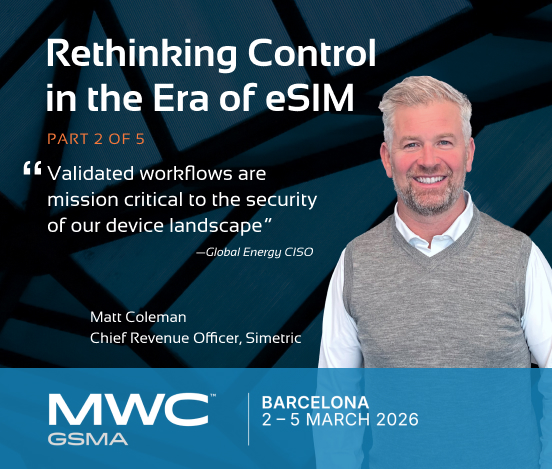 At scale, eSIM programs don’t fail because standards are missing. They fail because execution is assumed rather than validated.
eSIM fundamentally changes the operating model. Profiles are downloaded, activated, migrated, and retired dynamically—often without human intervention. Every transition introduces operational and security risk if outcomes aren’t validated end to end.
- For CISOs, this is a security concern. Identity, authorization, and policy enforcement can drift during profile changes when systems briefly disagree about state.
- For product teams, it’s an execution challenge. Silent failures surface later as connectivity issues, escalations, and loss of trust in automation.
Successful eSIM adoption certainly starts with finding the right eIM provider, or providers. But to be clear, as SGP .32 rolls out, there are industry leaders and others still in development. Some tie connectivity to their solution which further bifurcates device ecosystems from existing MNO relationships.
Variability exists and should be understood. Once a selection is made, efforts must quickly move to validate operational readiness that accounts for both device and carrier positions:
- Industry standards compliance is necessary, not sufficient for internal execution procedures
- Workflows must be validated end-to-end—refined effortlessly
- Device, CMP readiness, and enterprise state must remain aligned
- Execution must be continuously observed, not assumed, in real time
This is where execution validation becomes real.
Simetric’s Single-pane-of-glass (SPoG) platform sits at the center of this framework as the execution and validation engine between the RSP and MNO’s CMPs. We work closely with key eIMs to ensure functionality from RSP to CMP to device is flawless. Workflow is validated. The SPoG does not replace devices, carriers, or eSIM management platforms. Instead, it serves the enterprise and administrators by validating how those components behave together in real-world workflows to ensure control is both monitored and refined in near-real time.
When vendors claim SGP.32 support, Simetric is where that support is exercised and proven. Profile downloads, activations, migrations, and retries are executed through coordinated workflows and observed across device behavior, network response, and enterprise systems of record.
The result is visibility when compliant systems disagree, the ability to reconcile state across vendors, and confidence that execution matches intent. Simetric turns SGP.32 from a declared capability into a provable, auditable one that is also commonly managed across existing SIM enabled devices. Unified provisioning and orchestration are essential for managing the entire device ecosystem plus the migration to eSIM.
Unified control is essential, because as fast as eSIM discussions pop up, the use cases are evolving rapidly. Take for example, Simetric was presented with a request from a device manufacturer. We met their market strategy with eSIM Modem Manager to provide an intelligent modem control plane. It provides complete control over the cellular modem—monitoring connection health, switching APNs and profiles on demand, and automatically recovering from failures without human intervention. It isn’t connectivity. It is dynamic eSIM device and data control.
SGP .32 is a solid advancement for any organization to consider. From a utilization perspective, eSIMs rarely fail loudly. They fail quietly in failed organizational discipline —later—and at scale. Organizations that treat validation as a core execution and security control—not an afterthought—are the ones that adopt eSIM successfully.
Adoption isn’t about supporting eSIM.
It’s about proving it works – every time – every use case – at scale.
In the next post in this series, we examine common and SIM and eSIM orchestration